Spiritual Practices
Shamanic Womancraft
Shamanic Womancraft: Ancient Women's Wisdom for the Modern World
There's a particular kind of hunger that brings women to Shamanic Womancraft. It's not always easy to name. It might show up as a sense that something important has been lost, or a feeling of disconnection from their own bodies, or a longing for the kind of honest, grounded community with other women that modern life rarely seems to offer. Whatever brings someone to this practice, the invitation at its centre is the same: come back to yourself.
Shamanic Womancraft is a women's practice that weaves together shamanic traditions, rites of passage work, and cyclical living. It was developed in Australia by midwife and teacher Jane Hardwicke Collings, whose four decades of attending births and supporting women through the transitions of their reproductive lives gave her an unusually clear view of what modern culture tends to get wrong: we've stripped the great passages of a woman's life of their meaning. First blood, pregnancy, birth, miscarriage, menopause. Events that were once held in ceremony and community become things to push through quietly and alone. Shamanic Womancraft is, in part, a response to that loss.
This isn't a religion, and it doesn't ask you to hold any particular spiritual belief. What it does ask is a willingness to slow down, to take your own inner knowing seriously, and to sit in circle with other women with some degree of honesty.
Origins and History
Shamanism is among the oldest known spiritual and healing traditions on earth, with evidence of its practice in Siberia, Central Asia, the Americas, Africa, and Indigenous Australia stretching back tens of thousands of years. The word "shaman" comes from the Evenki people of Siberia and refers to those who could move between ordinary and non-ordinary states of consciousness to access wisdom, facilitate healing, and guide communities through times of transition.
Shamanic Womancraft emerged from that vast lineage, but with a specific focus: the experience of being a woman in a body that moves in cycles. Jane Hardwicke Collings founded the School of Shamanic Womancraft in New South Wales in the 1990s, bringing together her clinical background in midwifery with years of study in shamanism, women's mysteries, and rites of passage facilitation. Her central argument was that women's cyclical nature had been largely stripped of its significance in modern Western culture, and that restoring that meaning was itself a form of healing.
The practice also draws on the work of Clarissa Pinkola Estés, whose landmark book Women Who Run With the Wolvesexcavated the mythologies and stories that illuminate the instinctual feminine psyche, and the growing field of menstrual cycle awareness, developed in part by Alexandra Pope and Sjanie Hugo Wurlitzer, authors of Wild Power.

How It Works
Shamanic Womancraft operates across several interwoven layers, and a practitioner or facilitator will typically work with more than one of these at a time.
- The menstrual cycle as a map. This practice teaches that a woman's menstrual cycle mirrors the four seasons. The pre-ovulatory phase is like inner spring, fresh with possibility and new ideas. The ovulatory phase is like inner summer, warm and outwardly focused. The premenstrual phase is like inner autumn, bringing discernment, truth-telling, and the surfacing of what's unresolved. And the menstrual phase is like inner winter, a time for rest, dreaming, and access to deeper knowing. Learning to live with these rhythms rather than pushing against them is foundational to the work.
- Rites of passage. Shamanic Womancraft places enormous importance on conscious, witnessed transition. Menarche (a girl's first period), pregnancy and birth, miscarriage and loss, perimenopause, menopause, and even the approach of death are all understood as initiatory experiences. When these transitions are met with awareness, community, and ceremony, they become sources of wisdom rather than events simply to survive.
- Shamanic journeying. Sessions and circles often include guided shamanic journeys: meditative or trance-like states usually supported by rhythmic drumming. In these states, participants can access inner wisdom, meet guiding archetypes, or process experiences that ordinary waking consciousness doesn't always make available. These are not drug-induced states. They're a natural shift in awareness, similar to deep meditation, achieved through sound and focused intention.
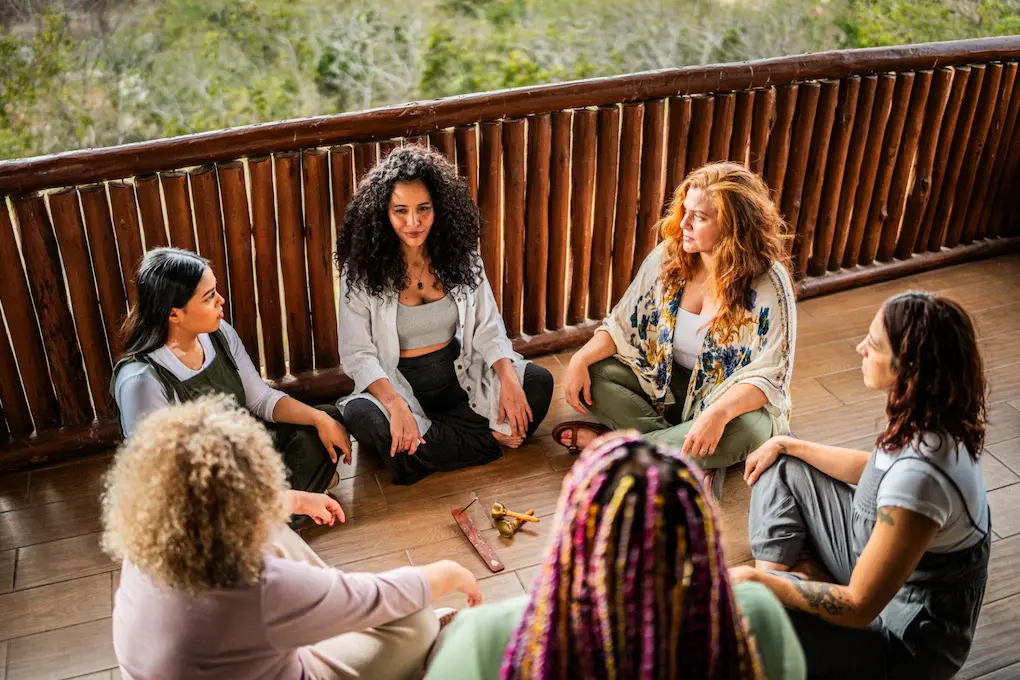
- Women's circles. The circle is central to this practice. Gathering in circle creates a held space where women speak honestly, are witnessed, and do the kind of collective healing that one-on-one therapeutic settings often can't provide. Circles may be held regularly through lunar or seasonal cycles, or as one-off gatherings for a specific intention or life moment.

The Menstrual Cycle as a Sacred Map
One of the most practically useful aspects of Shamanic Womancraft is how it reframes the menstrual cycle. Rather than treating it as a biological inconvenience or something to be managed, this practice holds it as a woman's most direct access point to her own cyclical nature and a source of self-knowledge.
Each of the four phases is understood to carry its own creative strengths and relational qualities. In the inner spring, women often find fresh energy and openness. The inner summer brings warmth and a natural ease with connection and communication. The inner autumn can be more challenging, but it's also the phase where women often see most clearly what isn't working and what they actually want. The inner winter, the days around menstruation itself, are understood not as a time of limitation but as the most direct access point to intuition and deeper knowing.
This framework, sometimes called the Inner Seasons model, has been developed in detail by Alexandra Pope and Sjanie Hugo Wurlitzer through the Red School. Women who begin tracking their cycles through this lens often report that it transforms not just their relationship with their bodies but with their work, relationships, and creativity as well.
Rites of Passage: Marking What Matters
Rites of passage work sits at the heart of Shamanic Womancraft, and it's one of the places where this practice addresses something genuinely missing in modern life.
A menarche ceremony, which marks and celebrates a girl's first period, can be one of the most meaningful gifts a family gives. In a culture that tends to treat first menstruation with embarrassment or silence, a thoughtfully held ceremony offers something entirely different: dignity, welcome, and a sense of stepping into something rather than just enduring it.
Similarly, birth, pregnancy loss, and menopause are recognised as major initiatory experiences that benefit from ceremony, community, and intentional support. Many women who work with Shamanic Womancraft practitioners through these transitions describe the experience as qualitatively different from medical care alone. Not better, and not a replacement, but a different kind of holding.

What Shamanic Womancraft Can Help With
Shamanic Womancraft is a complementary practice, not a medical treatment, and it works best alongside rather than instead of conventional care where that's needed. That said, it can be meaningfully supportive for :
- Women navigating rites of passage such as menarche, pregnancy, birth, postnatal recovery, perimenopause, and menopause.
- Those experiencing cycle-related distress, including painful periods, premenstrual mood difficulties, or a deep sense of disconnection from their bodies, often find it useful.
- Women processing grief, loss, trauma, or major life upheaval are drawn to it, as are those seeking a more meaningful relationship with their creativity, intuition, and sense of purpose.
- And perhaps most simply, many women come because they're missing the kind of honest, embodied community with other women that modern life often doesn't provide.
What to Expect in a Session or Circle
Your experience will vary depending on the format and the practitioner. A one-on-one session typically begins with conversation about what's currently alive for you, your cycle, your life circumstances, your intentions. From there, a practitioner might guide you through a shamanic journey, support you with ceremony or creative practice, or use body-based approaches to help you integrate what arises.
A group circle tends to open with grounding and welcome, move through some form of ceremony or shared intention, include space for journeying, movement, or creative expression, and close with integration. You're never required to share more than you want to, and the circle format is designed to feel safe rather than performative.
Residential retreats, often held over a weekend or longer, offer the deepest immersion. Many women describe these as genuinely transformative, particularly when held in natural settings with a group that's willing to go into the work together. They're not for everyone, and they're certainly not necessary as a starting point. But for women who are ready, they tend to be the kinds of experiences that mark a before and after.

Shamanic Womancraft and Ancestral Healing
One dimension of Shamanic Womancraft that isn't always immediately obvious is its engagement with ancestral and lineage healing. Many women come to this practice carrying patterns that don't feel entirely their own: fears, physical symptoms, relational dynamics that seem to predate their own experience. Working with ancestral lines through shamanic approaches, ceremony, and intention can be a profound way of understanding and, in some cases, releasing these patterns.
This isn't a clinical claim, it's a spiritual and experiential one. But it's one that many women find meaningful, particularly those who've done significant amounts of therapeutic work and find that something still seems to sit beneath what therapy reaches.
Frequently Asked Questions
Is Shamanic Womancraft a religion or a spiritual path?
No. It draws on spiritual traditions from many cultures, but it's not a religion and doesn't ask you to adopt any particular belief system. It's compatible with existing spiritual practices, including Christianity, Buddhism, and others, as well as with a completely secular worldview. What it requires is curiosity and a willingness to be present with yourself.
Do I need any prior experience with shamanism or women's spirituality?
None at all. Many women come with no background in these areas, and skilled facilitators hold space for beginners and experienced practitioners alike. The practices themselves are accessible to anyone who comes with an open mind.
What's the difference between Shamanic Womancraft and general shamanism?
Shamanism is a broad category of healing and spiritual practice found across many cultures, centred on accessing non-ordinary states of consciousness for healing and wisdom. Shamanic Womancraft is a specific application of shamanic principles with women's experience at the centre: the menstrual cycle, women's rites of passage, and the circle as its primary frameworks.
Is it only for women who menstruate?
No. While menstrual cycle teaching is central to many aspects of the practice, Shamanic Womancraft is for women at all life stages. The seasonal model can also be applied to the lunar cycle or other natural rhythms, making it relevant for women who are postmenopausal, post-hysterectomy, or otherwise no longer menstruating.
Is it appropriate for younger people, including girls?
Yes. Menarche ceremonies are actually one of the most requested offerings within Shamanic Womancraft, and many practitioners work specifically with girls and families to mark this transition with care and dignity.
How do I find a qualified practitioner?
The most reliable path is through the School of Shamanic Womancraft (schoolofshamanicwomancraft.com), which trains and certifies practitioners in Australia and internationally. If you're exploring Shamanic Womancraft alongside other holistic modalities, Bodhi Holistic Hub connects you with vetted practitioners across a wide range of complementary approaches, including those working in women's spirituality and feminine healing, which can be a helpful starting point when you're still working out exactly what you're looking for.
Is it safe if I have a history of trauma?
For most women, yes. Circle work and shamanic journeying are generally gentle practices, though they can bring up deep emotions and memories. It's important to let your facilitator know about your history so they can hold the space appropriately. Shamanic Womancraft is not a substitute for professional trauma-informed therapeutic support, but it can complement that work well when both are in place.
References and Further Reading
Professional Organisations
- School of Shamanic Womancraft — The primary training and certification body for this practice, founded by Jane Hardwicke Collings. The most authoritative source on its principles, curriculum, and practitioner training.
- Red School — Founded by Alexandra Pope and Sjanie Hugo Wurlitzer, the Red School offers research-informed resources on menstrual cycle awareness and the Inner Seasons model that underpins much of the cyclical living aspect of Shamanic Womancraft.
Research and Scientific Foundation
- Jean Hailes for Women's Health — A leading Australian research organisation focused on women's health across all life stages, with evidence-based resources on menstrual health, perimenopause, menopause, and women's wellbeing that provide helpful context for the health dimensions of this practice.
- National Centre for Complementary and Integrative Health — Provides research and evidence reviews on mind-body practices, including meditation and relaxation-based approaches relevant to the journeying and circle work within Shamanic Womancraft.
Related Modalities
- Women drawn to Shamanic Womancraft often find deep resonance with Shamanic Healing more broadly, which provides a wider cosmological framework for working with guides, ancestors, and soul-level healing beyond the specifically feminine focus.
- Closing of the Bones is a deeply nourishing postpartum ceremony with roots in Mexican tradition, one that many Shamanic Womancraft practitioners also offer and that similarly honours major transitions in a woman's body.
- Fertility and Pregnancy Intuitive Healing works with the energetic and emotional dimensions of conception, pregnancy, and loss, complementing the womb-centred focus of Shamanic Womancraft beautifully.
- Breathwork, which uses conscious connected breathing to access altered states and release stored emotion, shares this practice's foundational understanding that the body holds wisdom the thinking mind doesn't always have access to.
Related Articles
The Healing Power of Rebozo Massage in Postpartum Care - Ysaline Godet
Tracking Your Body's Rhythms: A Woman's Guide to the Menstrual Cycle - Sarina Coventry
This guide was written by the Bodhi Holistic Hub team according to their editorial policy.
Last Updated : May 2026
Your menstrual cycle is your curriculum.
Alexandra Pope, Co-founder of the Red School and co-author of Wild Power
Discover our vetted practitioners
Brook River
View Profile
Bianca Havukainen
View Profile