Spiritual Practices
Tarot Reading
What Is Tarot Reading?
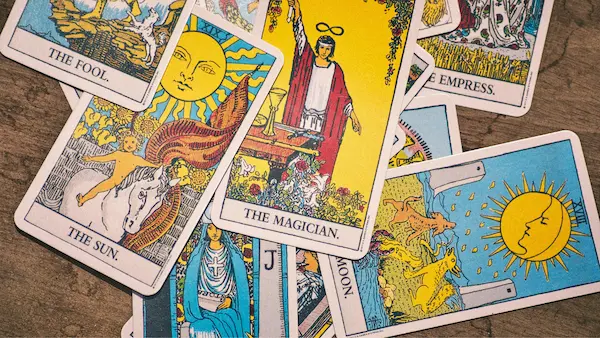
Tarot reading is a practice of using a deck of 78 symbolic cards to gain insight, clarity, and perspective on life's questions and situations. When you sit down with a tarot reader or pull cards yourself, you're not getting your fortune told in the way films might suggest. You're engaging with a symbolic language that helps illuminate patterns, possibilities, and aspects of yourself you might not be consciously aware of.
The tarot deck consists of 78 cards divided into two main sections. The Major Arcana contains 22 cards representing significant life themes, major turning points, and archetypal energies like The Fool, The Lovers, Death, and The World. These cards speak to the big, transformative moments and lessons in your life. The Minor Arcana contains 56 cards divided into four suits (Wands, Cups, Swords, and Pentacles), much like regular playing cards. These address day-to-day experiences, challenges, and opportunities in areas like creativity, emotions, thoughts, and material concerns.
What makes tarot powerful isn't magic in the supernatural sense. It's the way the cards' rich symbolism and imagery speak to your unconscious mind and intuition. When a skilled reader interprets the cards, they're drawing connections between the imagery, the traditional meanings, your specific question or situation, and their intuitive sense of what's emerging. The cards become a mirror reflecting back insights you already hold within but might not be able to access through ordinary thinking.
People use tarot for gaining perspective on relationships, career decisions, and life transitions, understanding patterns and behaviours that keep them stuck, processing emotions and difficult experiences, tapping into their intuition and inner wisdom, exploring possibilities and potential outcomes, and supporting personal growth and self-discovery. Tarot works best when approached as a tool for reflection and empowerment rather than as a way to predict a fixed future.
The Fascinating History of Tarot
Tarot's history is far more practical than mystical, which might surprise people who assume these cards have always been used for divination. The story begins in 15th-century Italy, where tarot cards were created as a card game for wealthy families.
The earliest known tarot decks date to the 1440s and 1450s in northern Italian cities like Milan, Venice, Florence, and Urbino. These hand-painted luxury decks were commissioned by noble families like the Viscontis and Sforzas as symbols of their status and wealth. The Visconti-Sforza deck, created around 1450 and attributed to artist Bonifacio Bembo, remains one of the most famous historical tarot decks.
These early cards were designed for playing tarocchi, a trick-taking card game similar to bridge. The standard deck included four suits (Cups, Swords, Batons, and Coins) with cards numbered one through ten, plus four court cards (Page, Knight, Queen, and King). What made tarot unique was the addition of 21 trump cards featuring figures like The Emperor, The Lovers, Justice, and Death, plus The Fool, which served as a wild card.
Tarot remained purely a game for about 300 years. References to tarot from the 15th, 16th, and 17th centuries mention it only as entertainment or gambling, sometimes criticised by the church for this reason, but never as a divination tool. Playing card games used for fortune-telling existed during this period, but tarot specifically wasn't among them.
Everything changed in 1781 when French occultist Antoine Court de Gébelin published a treatise claiming that tarot cards contained ancient Egyptian wisdom. He theorised that the cards preserved esoteric secrets of Egyptian priests, forced to hide their knowledge in a game to ensure its survival. Court de Gébelin's claims were elaborate and entirely unsubstantiated. Modern scholarship has thoroughly debunked the Egyptian connection. But his romantic theory captured imaginations and transformed how people viewed tarot.
Following Court de Gébelin, French cartomancer Jean-Baptiste Alliette (known as Etteilla) published the first definitive guide to tarot card reading in the 1780s, laying foundations for using tarot as a spiritual and personal growth tool. Throughout the 19th century, occultists assigned elaborate symbolic systems to the cards, linking them to astrology, Kabbalah, numerology, and elemental correspondences.
The most influential development came in 1909 when British occultist Arthur Edward Waite commissioned artist Pamela Colman Smith to create a new tarot deck. The Rider-Waite-Smith deck (named for its publisher, Waite, and Smith) revolutionised tarot. Previous decks showed only suit symbols on the Minor Arcana cards. Smith painted evocative scenes on every single card, making the entire deck intuitively readable through imagery alone. Her artistic vision, combined with Waite's occult knowledge and symbolism, created the most influential and widely used tarot deck in history.
Smith's contribution was enormous, yet she was poorly compensated and her name omitted from early printings. The deck was marketed as the Rider-Waite deck, erasing the artist who made it accessible. Modern tarot communities increasingly call it the Rider-Waite-Smith or Waite-Smith deck in recognition of her essential work.
Tarot experienced renewed popularity after World War I as people sought spiritual connection with loved ones lost in the war. Interest surged again in the 1960s and 70s alongside broader New Age movements. Today, tarot has exploded in mainstream culture, with thousands of unique decks available and vibrant communities sharing readings on social media.
How Tarot Reading Actually Works
Understanding how tarot works requires setting aside ideas about supernatural fortune-telling and looking at what's actually happening in a reading. Tarot functions primarily through symbolism, archetypal imagery, intuition, and psychological projection.
The cards themselves contain no inherent magical power. They're cardboard with ink. What gives them meaning is the rich symbolic language they speak and your mind's ability to find personal significance in that symbolism. Carl Jung, the influential psychologist, was fascinated by tarot because he recognised that the cards depict universal archetypes, fundamental patterns of human experience that exist in what he called the collective unconscious.
When you look at The Tower card showing a structure struck by lightning with figures falling, your mind immediately grasps concepts of upheaval, sudden change, and structures collapsing. When you see The Empress surrounded by abundant nature, themes of creativity, nurturing, and fertility emerge. These aren't arbitrary associations. They're patterns humans have recognised across cultures and throughout history.
During a reading, several psychological processes occur simultaneously. First, you're bringing a question or situation to the cards with focused attention. This alone is valuable. How often do you really sit with a question and give it your full awareness? Then, as cards are revealed, your mind begins making connections between the imagery, your situation, and possibilities you hadn't considered. This is called synchronicity or meaningful coincidence.
Some readers and clients believe there's a genuine mystical component, that something beyond psychological processes is at work, whether that's universal consciousness, spirit guides, divine intelligence, or simply the mystery of how intuition functions. Other readers approach tarot as entirely psychological, a profound tool for accessing unconscious knowledge through symbolic engagement. Both perspectives can lead to powerful readings.
What skilled readers do is hold space for this process. They've studied the traditional meanings of the cards, understand the symbolic language, know multiple card combinations and their typical interpretations, but they're also deeply tuned into their intuition. They notice which cards draw their attention, what images stand out, how the cards relate to each other in the spread, and most importantly, how the querent (person receiving the reading) responds. A good reader watches your face, listens to your questions, and adjusts their interpretation based on what's resonating.
Reading tarot is as much art as science. It requires knowledge of the card meanings but also creativity, empathy, intuitive perception, and the ability to weave cards together into a coherent narrative that speaks to your specific situation.
The Structure of a Tarot Deck
Understanding a tarot deck's structure helps you grasp how readings work. The 78 cards divide into Major and Minor Arcana, each serving different purposes.
The 22 Major Arcana cards represent the significant themes, lessons, and archetypes you encounter through life. They're often called the Fool's Journey because they follow a narrative arc from The Fool (numbered 0, representing innocence and new beginnings) through various teachers and experiences to The World (numbered 21, representing completion and fulfillment).
Major Arcana cards typically indicate important life events, significant choices, deep psychological work, spiritual lessons, or major turning points. When multiple Major Arcana cards appear in a reading, it suggests the situation carries weight and long-term significance.
The 56 Minor Arcana cards address everyday experiences and situations. They're divided into four suits, each corresponding to an element and life domain.
Wands represent the fire element and relate to creativity, passion, inspiration, career, ambition, and willpower. When Wands appear, you're often looking at energy, action, and drive.
Cups represent the water element and govern emotions, relationships, intuition, and creativity. Cups speak to how you feel, your connections with others, and your emotional wellbeing.
Swords represent the air element and address thoughts, communication, conflict, decisions, and mental challenges. Swords can indicate both clarity of thought and painful truths, battles both external and internal.
Pentacles (sometimes called Coins) represent the earth element and deal with material concerns, finances, work, health, and physical manifestation. Pentacles ground you in practical matters and tangible results.
Each suit contains 14 cards: Ace through Ten (the pip cards) and four court cards (Page, Knight, Queen, and King). The numbered cards progress through a cycle of experiences within that suit's theme. Aces represent new beginnings and pure potential in that element. Twos address balance and choices. Threes bring initial manifestation. And so on through to Tens, which represent completion or culmination of that suit's journey.
Court cards can represent actual people in your life, aspects of your own personality, or approaches and attitudes you're embodying or encountering. Pages suggest new beginnings, learning, and youthful energy. Knights indicate action, movement, and pursuit of goals. Queens embody mature, receptive, nurturing mastery of their element. Kings represent mature, active, authoritative command of their element.

What Happens in a Tarot Reading Session
When you book a session with a professional tarot reader, here's typically what occurs. Your first session usually lasts 60 to 90 minutes, though some readers offer shorter introductory sessions.
You'll start with a conversation. Your reader might ask what brings you to tarot, whether you have specific questions or prefer a general reading, and what you're hoping to gain from the session. Good readers create a comfortable, non-judgemental space where you can be honest about what's really going on.
Some readers prefer you to come with specific questions. Others work better with open-ended exploration. There's no wrong approach, though specific questions often yield more focused insights. Instead of "What does my future hold?" try "What do I need to understand about my current relationship?" or "What's blocking me from moving forward in my career?"
Your reader will shuffle the cards whilst holding your question or situation in mind. Different readers have different methods. Some shuffle until cards fall out. Others spread cards face-down and let you choose. Some cut the deck in particular ways. The method matters less than the intention behind it.
Once cards are drawn, your reader lays them out in a spread. Spreads are specific patterns where each position has a designated meaning. A simple three-card spread might represent past, present, and future, or situation, action, and outcome. The Celtic Cross, one of the most popular complex spreads, uses ten cards to examine a situation from multiple angles. Readers choose spreads based on your question and their reading style.
As your reader interprets the cards, they're drawing on multiple sources of information. They know the traditional meanings but aren't just reciting from a book. They're noticing relationships between cards, patterns in suits or numbers, visual elements that stand out, their intuitive impressions, and your reactions to what's being said. Good readers make the session interactive. They'll ask if something resonates, check their interpretation against your experience, and adjust their approach based on your feedback.
Readings aren't one-way transmissions where you sit passively receiving information. You're an active participant. When something your reader says doesn't fit, speak up. When something lands with surprising accuracy, let them know. This dialogue helps your reader give you the most relevant insights.
Towards the end, your reader usually summarises key themes and offers practical guidance. The best readers help you see actionable steps or perspectives you can apply to your situation. You might leave with specific advice, new ways of thinking about your circumstances, validation of things you already sensed, or questions to contemplate further.
Many readers offer recordings of your session or written summaries. Readings contain a lot of information, and having something to refer back to helps you integrate the insights over time.
Learning to Read Tarot for Yourself
You don't need to visit professional readers to benefit from tarot. Many people learn to read for themselves, finding it a powerful tool for self-reflection and personal development.
Starting with tarot begins with choosing a deck. The Rider-Waite-Smith deck is often recommended for beginners because its imagery is clear and most learning resources reference it. But if another deck's artwork speaks to you more strongly, follow that attraction. You'll connect more deeply with cards whose imagery resonates with you.
Learn the cards gradually. Don't try to memorise all 78 meanings immediately. That's overwhelming and unnecessary. Start by pulling one card each morning and sitting with it. Look at the imagery. Notice what draws your attention. Read about the card's traditional meanings. Then notice throughout your day how that card's themes appear in your experiences. This daily practice builds familiarity faster than trying to study cards intellectually.
Pay attention to your first impressions. When you look at a card, what's your immediate response before your thinking mind engages? That intuitive hit is valuable. Tarot reading is deeply intuitive. Yes, knowing traditional meanings helps, but your personal, intuitive connection to the imagery matters more.
Learn the suits and numbers, as these provide frameworks for understanding. Once you grasp that Wands relate to passion and action, Cups to emotions, Swords to thoughts, and Pentacles to material concerns, you can intuitively sense what a card might mean even if you don't know its specific traditional interpretation. Similarly, understanding number symbolism helps. Fives often indicate conflict or challenge. Nines suggest near-completion. Aces represent pure potential and new beginnings.
Practice with simple spreads. A single card offers guidance for the day. Three cards can explore past-present-future or situation-action-outcome. As you gain confidence, try more complex spreads. But even experienced readers often prefer simple layouts for their clarity and directness.
Read for friends and family once you feel somewhat comfortable. Real readings for others teach you things self-readings can't. You'll develop your interpretive skills, learn to trust your intuition with less attachment to being "right," and get comfortable communicating insights to others.
Keep a tarot journal. Record your readings, what cards appeared, your interpretations, and later, what actually happened or how the reading proved relevant. This reflection deepens your understanding and helps you recognise patterns in how certain cards show up for you.
Join tarot communities online or locally. The Tarot Guild of Australia and other organisations offer workshops, meetups, and resources for learners. Connecting with other enthusiasts provides support, different perspectives, and opportunities to practice.
The Role of Intuition in Tarot Reading
Intuition is the heart of tarot reading. Yes, you can learn card meanings from books. But tarot becomes powerful when you trust that quiet inner knowing that arises when you look at the cards.
Intuition is a way of knowing that doesn't come through logical reasoning. Information arrives from your subconscious, from pattern recognition happening below conscious awareness, from the accumulated wisdom of your life experiences, or perhaps from something more mysterious. In tarot, intuition manifests as impressions, images that pop into your mind, feelings about what a card means in context, words or phrases that arise unbidden, or simply a sense of what's true.
Developing your intuition with tarot takes practice. Start by noticing the voice. When you look at a card, what does that quiet inner voice say before your analytical mind starts working? That first impression is often your intuition speaking. Learn its tone, its quality. It's usually quieter than your thinking mind, more feeling-based than word-based, neutral rather than anxious or overly excited.
Trust it even when it doesn't make logical sense at first. Sometimes intuitive hits won't fit with the traditional card meaning. Go with your intuition anyway. Explain to the person you're reading for that you're getting this impression and see if it resonates. You'll be surprised how often these intuitive leaps prove more accurate than sticking rigidly to textbook meanings.
Create space for intuition to speak. Rushing through readings, anxiously trying to be "right," or being too caught up in your head blocks intuitive flow. Take your time. Breathe. Let your gaze soften as you look at the cards. Notice what you notice without forcing it.
Intuition grows stronger with use. The more you practise trusting those quiet knowings, the clearer and more reliable they become. Your intuition is like a muscle. Exercise it regularly and it strengthens.
Common Questions About Tarot Ethics and Approach
Responsible tarot reading involves ethical considerations. Good readers approach their practice with integrity and respect for clients.
Tarot shouldn't create dependency. The best readers empower you to make your own decisions rather than making you reliant on them for answers. They offer perspective and insight but never take away your autonomy.
Readers don't claim to predict a fixed future. The future isn't set in stone. Your choices and actions shape what unfolds. Tarot shows possibilities, likely outcomes if current trajectories continue, and energies at play. It doesn't show a predetermined destiny you're powerless to change.
Responsible readers know their limitations. They're not medical doctors, therapists, or financial advisers. When someone's question falls outside their scope, ethical readers refer them to appropriate professionals. A person showing signs of serious mental health issues needs a psychologist, not just tarot readings.
Readers maintain appropriate boundaries. They don't use readings to manipulate, scare, or extract money from vulnerable people. The stereotype of the fortune teller who sees danger and charges for additional readings to remove curses? That's exploitative nonsense that real practitioners condemn.
Good readers respect your free will and privacy. They don't read for people without their knowledge or consent. Reading someone without permission violates their autonomy. They also keep reading content confidential unless you give permission to share.

Choosing Between Different Types of Readings
Tarot readers work in different styles, and understanding these helps you choose what suits your needs.
Some readers work primarily with traditional meanings and established correspondences. They've studied the cards' connections to astrology, numerology, Kabbalah, or other symbolic systems. Their readings draw on this accumulated wisdom, offering interpretations grounded in centuries of tarot tradition. This approach provides structure and depth, particularly valuable when you want comprehensive, well-rounded perspectives.
Other readers work more intuitively, letting imagery and gut feelings guide their interpretations. They might look at a card and receive impressions that don't align with traditional meanings but prove startlingly accurate for your specific situation. Intuitive readers bring fresh, personal insights that can bypass your defences and speak directly to your unconscious.
In practice, most skilled readers blend both approaches. They know traditional meanings but aren't enslaved to them. They trust their intuition but also draw on established wisdom. The best readings happen when knowledge and intuition dance together.
Some readers incorporate other practices into their work. They might combine tarot with astrology, using your birth chart alongside the cards. Others integrate energy healing, meditation, or counselling approaches. Some specialise in particular areas like relationship readings or career guidance.
Consider what you're looking for. Do you want practical, grounded advice? Seek readers who work with real-world applications. Seeking spiritual growth and deep inner work? Look for readers with that orientation. Want someone direct and no-nonsense? Or prefer a gentler, more exploratory approach? Reader style matters as much as skill level.
What to Expect from Your First Reading
If you've never had a tarot reading, you might feel nervous or uncertain about what to expect. That's completely normal. Here's what will likely happen and how to get the most from the experience.
Come with an open mind but also healthy scepticism. You don't have to believe anything supernatural is happening to benefit from tarot. Approach it as you would any reflective practice that helps you access different perspectives.
Prepare your questions beforehand if you want to address specific concerns. Write them down so nervousness doesn't make you forget. But it's also fine to come with a general "What do I need to know right now?" and see what emerges.
Be honest with your reader. If something they say doesn't resonate, speak up. If you're confused, ask for clarification. Readings work best as collaborative conversations, not pronouncements from on high that you passively receive.
Take notes or ask if your reader will record the session. You'll likely remember only a fraction of what's said in the moment. Having something to review later helps you integrate insights as situations unfold.
Don't take everything literally. Tarot speaks in symbols and metaphors. If Death appears, you're not about to die. It represents endings, transformations, and necessary closures that make space for new beginnings. A good reader will explain this symbolic language.
Give insights time to unfold. Some things your reader says might not make sense immediately. Write them down anyway. Days or weeks later, you might have an "aha" moment when the meaning becomes clear in light of new developments.
Remember that you're in charge of your life. No matter what cards appear or what your reader says, you make your own choices. Use tarot as a tool for reflection and self-awareness, not as a rulebook dictating your path.
Frequently Asked Questions
Is tarot reading against any religion?
This depends on your specific religious tradition and how you personally interpret tarot. Some Christian denominations cite biblical passages about divination and view tarot as spiritually dangerous. Other Christians see tarot as a psychological tool or symbolic system compatible with their faith. Judaism, Islam, Buddhism, Hinduism, and other religions have varied perspectives, with some adherents embracing tarot and others avoiding it. Many tarot readers don't connect the practice to any specific religion, approaching it as secular personal development. If you have religious concerns, explore your own tradition's teachings and make an informed decision that aligns with your beliefs.
Can tarot predict the future?
Tarot doesn't predict a fixed, inevitable future because no such thing exists. Your choices and actions continually shape what unfolds. What tarot can do is show likely outcomes if current patterns continue, energies and influences currently at play, potential opportunities and challenges ahead, and psychological patterns affecting your trajectory. Think of it as showing weather patterns rather than absolute forecasts. You might see storm clouds gathering, giving you time to prepare or change course. The future remains flexible and influenced by your free will.
How do I know if a tarot reader is genuine?
Look for several indicators. Genuine readers create safe, non-judgemental spaces and never use fear tactics or pressure. They empower you to make your own decisions rather than creating dependency. They're honest about tarot's limitations and don't claim supernatural powers or guaranteed predictions. They have clear ethics about what they will and won't read about. They charge reasonable, transparent fees without upselling "curse removals" or additional expensive services. They have testimonials or referrals from satisfied clients. Most importantly, trust your gut. If something feels off about a reader's energy or approach, listen to that instinct and find someone else.
How often should I get tarot readings?
This varies based on your needs and relationship with tarot. Some people get readings monthly for ongoing guidance and reflection. Others book sessions only during major life transitions or when facing important decisions. Some learn to read for themselves and rarely need professional readers. There's no right frequency. However, be cautious about getting readings too often on the same question, especially from multiple readers seeking a particular answer. This suggests you're looking for someone to tell you what you want to hear rather than genuinely seeking insight. If you're getting readings weekly or constantly seeking guidance, that might indicate you're becoming dependent rather than empowered.
How much does a tarot reading typically cost in Australia?
In Australia, professional tarot readings typically range from $80 to $180 for a full session lasting 60 to 90 minutes. Shorter readings of 30 minutes might cost $50 to $80. Prices vary based on the reader's experience, reputation, qualifications, location, and session length. Some readers offer sliding scale fees for people experiencing financial hardship. Premium readers with years of experience and strong reputations may charge $200 or more. Be wary of readers charging extremely low rates (which might indicate lack of training or seriousness) or extremely high rates combined with pressure tactics (which might indicate exploitation).
Can I learn tarot reading myself?
Absolutely. Many skilled readers are self-taught through books, online resources, and practice. Learning tarot requires studying card meanings and symbolism, understanding spreads and reading techniques, developing your intuition and interpretive skills, practising regularly with yourself and others, and engaging with tarot communities for support and perspective. The Tarot Guild of Australia offers courses and workshops for learners at various levels. Numerous books provide excellent foundations. Online communities offer practice opportunities and feedback. Anyone willing to invest time and curiosity can learn tarot. Some people have natural intuitive gifts that make reading easier, but like any skill, tarot reading improves significantly with dedicated practice.
Should I buy my own tarot deck or receive one as a gift?
There's an old superstition that you must receive your first tarot deck as a gift, not purchase it yourself. This is entirely untrue. Buy your own deck. In fact, choosing your own deck means you'll select artwork and imagery that resonates with your personal aesthetic and intuition, which will strengthen your connection to the cards. The Rider-Waite-Smith deck is the most common starting point because its imagery is clear and most resources reference it, but if another deck calls to you more strongly, trust that attraction. Your connection to the deck matters more than following arbitrary rules.
References and Further Reading
Professional Organisations
- Tarot Guild of Australia
- Australian Tarot Conference
- International Tarot Foundation
Research and Historical Resources
- The Encyclopaedia of Tarot
- The Metropolitan Museum of Art - Tarot Collection
- Collectors Weekly - Tarot History
Educational Resources
- "Seventy-Eight Degrees of Wisdom" by Rachel Pollack
- "The Tarot Bible" by Sarah Bartlett
- "Tarot for Your Self" by Mary K. Greer
- "The Tarot: History, Symbolism, and Divination" by Robert M. Place
Related Modalities
- Astrology – Ancient system using celestial patterns for insight and guidance, often combined with tarot by practitioners.
- Numerology – Symbolic system working with numbers' meanings and patterns, which underlies much tarot interpretation.
- Rune Reading – Norse divination system using ancient symbols carved on stones or wood, offering different symbolic language for guidance.
- I Ching – Ancient Chinese divination system using hexagrams and philosophical text, providing wisdom through symbolic interpretation.
This guide was written by the Bodhi Holistic Hub team according to their editorial policy.
The cards themselves contain no inherent magical power. What gives them meaning is the rich symbolic language they speak and your mind's ability to find personal significance in that symbolism.
Tarot Wisdom Traditions
Discover our vetted practitioners

Gaddam Sai Meghna Reddy
View Profile
Polly Staniford
View Profile
Agatha Carmen
View Profile
Yasmin McFadden
View Profile
Meagan Roberts
View Profile