
Fertility & Birth
Menarche Ceremony
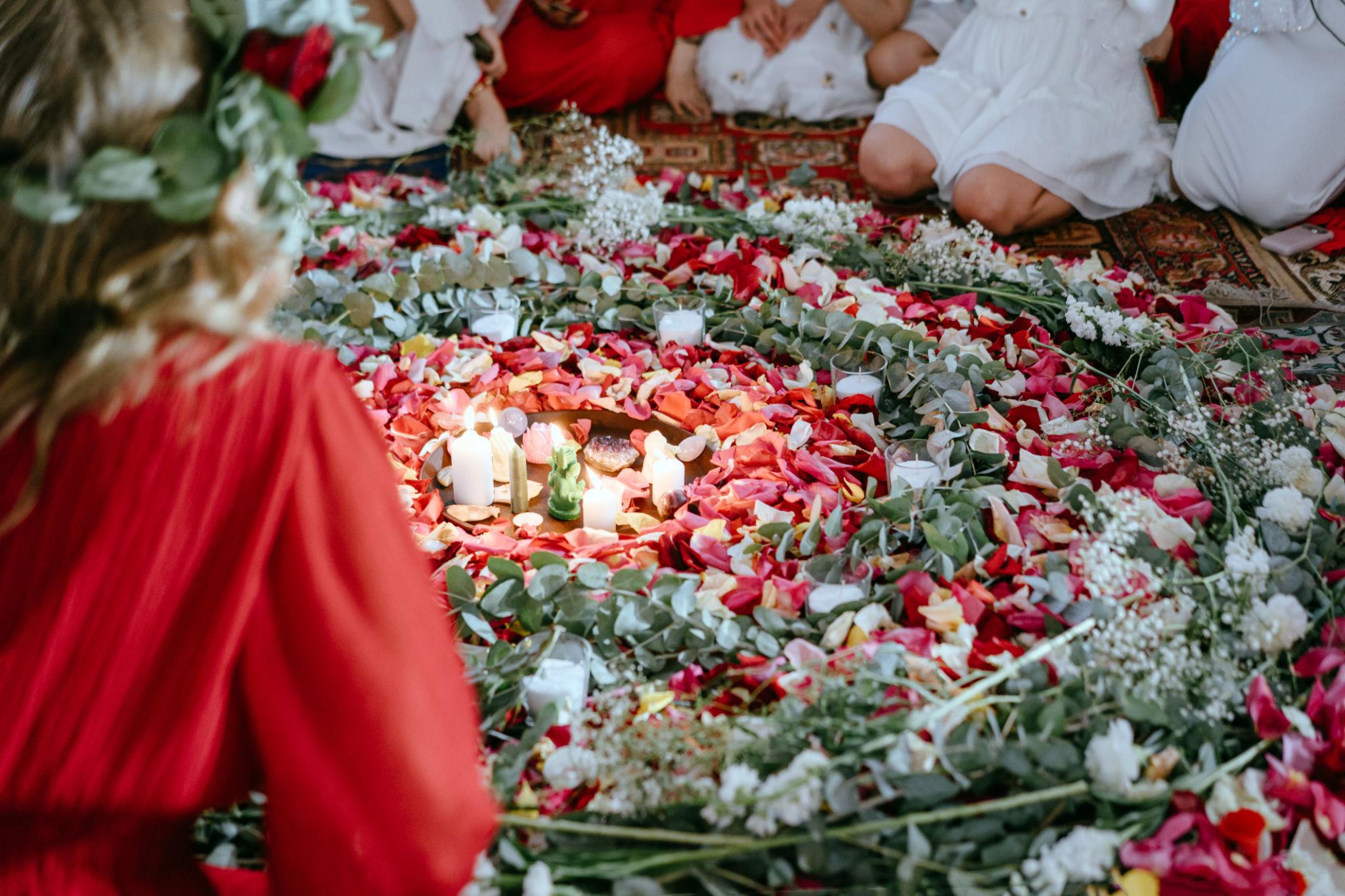
Menarche Ceremony: Honouring the First Blood as a Rite of Passage
There's a moment most women remember, not always fondly. The first period arrives, often unexpectedly, and the response it gets from the world around us sets the tone for how we'll relate to our bodies and our cycles for years to come. For many women, that moment was met with silence, embarrassment, or a hushed hand-off of pads and a quick explanation. For some, it was handled beautifully. For most, something important was left uncelebrated.
A menarche ceremony is a ritual that marks a girl's first menstruation as a meaningful threshold, from girlhood into the early stages of womanhood. It can be a private, intimate moment between a mother and daughter, or a small gathering of trusted women. It doesn't require robes or incantations. What it requires is intentional acknowledgement: this matters, you matter, and your body is doing something remarkable.
Increasingly, menarche ceremonies are also being held retrospectively: for adult women who never received that acknowledgement, and who carry an unresolved relationship with their cycle, their body, or their sense of self as a woman.
Origins: A Tradition That Predates Modern Culture
Across virtually every indigenous and traditional culture, a girl's first blood was treated as one of life's most significant transitions. Far from being hidden or hushed, it was publicly honoured.
The Apache Sunrise Ceremony is perhaps the most well-documented. This four-day ritual involves the entire community, with the young woman temporarily embodying Changing Woman, the first and most revered female spirit in Apache cosmology. She dances facing the rising sun, runs in four directions to represent the stages of life, and receives blessings from elders and a medicine man. Research from the 1990s found that Navajo women who participated in puberty ceremonies reported significantly fewer menopausal difficulties decades later, suggesting the ceremony's effects extend well beyond the day itself.
In South India, the ceremony is called Ritu Kala Samskara or Ritusuddhi. Family and female friends gather; the young woman receives new clothes, flowers, jewellery, and blessings for health and fertility. In Japan, families traditionally prepared sekihan, sticky rice with adzuki beans to mark the occasion. In Sri Lanka, an astrologer charts the stars at the exact moment of menarche to read the girl's future, after which a ritual bathing ceremony takes place.
The Hupa people of California hold a ceremony called the Flower Dance, or Ch'iwal, lasting up to ten days, filled with teachings, song, and community support. In Morocco, the family gathers and the girl is showered with gifts. In Ghana and Nigeria, songs and dancing mark the transition.
What's striking across all these traditions isn't the specific ritual, but what's consistent: the act of bearing witness. The community shows up and says, "We see you. This is important."
In Western industrialised culture, that witness largely disappeared. The menarche ceremony is, in part, an effort to bring it back.

What Actually Happens in a Menarche Ceremony
There's no single format. A good facilitator will shape the ceremony around the individual, her age, temperament, comfort level, and what she needs most.
For a young girl experiencing her first period, a ceremony might be as simple as a warm bath drawn by her mother, a small gathering of the women she trusts most, a meal of red foods, some candles and flowers, and each woman sharing a short blessing or piece of wisdom she wishes she'd received at that age. Gifts with symbolic meaning, like a journal, a piece of jewellery, or a moonstone, are common.
For adult women attending a retrospective menarche ceremony, and these are increasingly popular in women's wellness circles across Australia, the structure tends to go deeper. A ceremony might include:
A sharing circle, where women speak honestly about their menarche experience. Many women are surprised to find grief or emotion emerging around a memory they thought they'd long since filed away.
A guided meditation or visualisation to reconnect with the younger self who first bled, offering her the love and acknowledgement she didn't receive at the time.
Anointing, whether with oil, flowers, or water, as a symbolic act of honouring the body.
Spoken blessings or commitments from the women present, offered as gifts to the person being honoured.
In many ceremonies, mothers play a central role not just as witnesses, but as storytellers. When mothers share their own experiences of menarche,often for the first time in an intentional space,it creates a powerful sense of continuity. It offers a glimpse into a time when women gathered across generations to guide and support one another through this transition, long before this rite of passage was lost in modern culture.
This intergenerational sharing often becomes one of the most meaningful parts of the ceremony, grounding the experience in lived reality rather than abstract symbolism.
In practice, it is often the mother who initiates the experience. Many mothers actively seek out these ceremonies, recognising what they themselves may have missed, and wanting something different for their daughters. What’s notable is that daughters, once introduced to the idea, frequently become genuinely excited to take part.
Rather than being imposed, the ceremony often becomes a shared decision—something entered into together.
A ritual closing, often with candles, herbal tea, shared food, or song.
The facilitator holds the space carefully. This isn't therapy, though it can be therapeutic. It's ceremony, which means it works through symbol, ritual, and community in ways that words alone can't always reach.

Why It Matters: The Psychology of Being Witnessed
The research is consistent on this point: how a girl experiences her menarche shapes her relationship with her body for a long time. A 1982 review published in the journal Adolescence found that the way menarche was received, by a mother, a carer, or the broader culture, significantly influenced whether the experience was integrated positively or became a source of shame. Girls who were prepared and supported had markedly different emotional outcomes than those who weren't.
A 2020 study in the Palgrave Handbook of Critical Menstruation Studies included a narrative from a twelve-year-old who had participated in a welcoming ceremony. She described feeling "special," "loved," and that "people will always be there" for her. Having that moment witnessed and honoured shaped how she understood her own changing body.
More broadly, research published in the American Journal of Public Health has shown that girls who receive adequate emotional support at menarche are less likely to engage in risky behaviour, have better body image, and are more confident navigating their reproductive health in the years that follow.
Practitioners working in this space often observe that these ceremonies do more than create a positive memory. When held with care and intention, they can meaningfully influence how a young girl relates to her body, her identity, and her sense of self moving forward. Some describe it as altering the trajectory of a girl’s life—not through a single moment, but through the foundation that moment creates.
The holistic model underpinning menarche ceremony work understands this intuitively: the body holds our stories. When something significant happens to us and goes unmarked, that absence doesn't disappear. It settles into us. Ceremony is one way to go back, fill that gap, and offer the body what it needed.
Retrospective Ceremonies: It's Never Too Late
One of the most powerful developments in this space is the growing number of adult women seeking retrospective menarche ceremonies. These aren't rare or fringe. Women in their thirties, forties, and beyond are attending circles and one-on-one sessions to revisit their first blood experience with adult awareness and compassionate company.
The logic is sound. If the way you received your menarche shaped your body image, your relationship with your cycle, your comfort in your own skin, then healing that narrative, even decades later, can shift something real.
Australian midwife and women's mysteries teacher Jane Hardwicke Collings has written extensively about this, describing reclaiming the menarche as "one of the most important things women can do." Her work has introduced the practice to thousands of Australian women and has helped establish the red tent tradition in this country as a meaningful container for women's healing and ceremony.
Common things that surface in retrospective menarche work include:
Unresolved grief or shame around the body that began at puberty. A sense of disconnection from the cyclical nature of the body. Difficulty with menstruation, physical symptoms, dread, or resentment toward the cycle. A feeling of having crossed into womanhood without ever being properly welcomed.
None of these are pathologies. They're the ordinary results of growing up in a culture that never learned to honour the feminine body's transitions. Ceremony can begin to address them.

The Red Tent: Ceremony's Communal Container
Many menarche ceremonies, especially group ones, take place within a Red Tent gathering. The red tent is a women's circle, often held during the new moon or the dark moon, inspired by ancient traditions of women gathering together during their bleeding time to rest, share stories, and pass down wisdom.
In contemporary Australian women's wellness culture, red tent gatherings have become spaces for women to support one another across all the thresholds of womanhood: menarche, pregnancy loss, birth, menopause. They're not religious, though they carry a spiritual quality. They're not therapy, though they create genuine healing. They're simply women witnessing women — which, it turns out, is exactly what many of us have always needed.
What to Expect When You Book a Session
If you're looking to hold a menarche ceremony for a daughter or young person in your life, or to attend a retrospective ceremony for yourself, sessions are typically offered in two formats: private or group.
A private session with a practitioner might run between 90 minutes and three hours. You'll usually have a conversation beforehand to discuss what feels right. The practitioner will guide the ceremony, holding space for whatever emotions arise, and offering structure that feels sacred without being prescriptive.
Group ceremonies are often held in workshop settings, weekend retreats, or women's circles. These carry a different energy. There's something uniquely powerful about going through this ritual alongside other women, many of whom are processing very similar experiences.
When looking for a practitioner, seek someone who has specific training or experience in women's rites of passage, womb work, or ceremonial facilitation. Bodhi Holistic Hub connects you with vetted practitioners who work in this space, making it easier to find someone whose approach genuinely resonates with you or your daughter.

Is It Right for Every Girl?
Not every girl will want a ceremony, and that's worth taking seriously. A menarche ceremony should never feel forced. Some girls will love the idea and can't wait for their turn. Others will feel embarrassed or private about it, and a small, quiet acknowledgement, a letter, a special meal, a meaningful gift, may be far more appropriate.
When a girl does feel open to it, especially when the invitation comes through a trusted relationship like her mother, the experience tends to land very differently—less as a ritual imposed, and more as something she steps into willingly.
The point isn't the ceremony itself. The point is acknowledgement, care, and the message that this transition matters and so does she. The form can be as simple or elaborate as she needs it to be. What matters is that someone shows up for her.
For adult women attending retrospective work, the same principle applies: it should feel like an invitation, not an obligation. Good facilitators understand this and will never push beyond what a participant is ready for.
Frequently Asked Questions
What is a menarche ceremony?
A menarche ceremony is a ritual that honours a girl's first menstruation as a meaningful rite of passage. It can be intimate or communal, simple or elaborate. Its purpose is to mark the transition into adolescence and womanhood with dignity, celebration, and loving acknowledgement.
Do menarche ceremonies have to be spiritual or religious?
No. While many ceremonies draw on spiritual traditions, they can be entirely secular. What matters is the intention: creating a meaningful, positive experience around a biological event that deserves recognition.
What is a retrospective menarche ceremony?
A retrospective ceremony is held for adult women who didn't have their first menstruation acknowledged in a positive or meaningful way. These sessions revisit that experience symbolically, offering healing and a sense of completion that was missing at the time.
Who facilitates menarche ceremonies?
Practitioners who offer menarche ceremony work typically come from backgrounds in women's health, shamanic facilitation, womb work, counselling, or ceremonial arts. It's important to choose someone with genuine experience in this area and a clear, ethical approach to holding space.
How do I find a qualified menarche ceremony practitioner?
Look for practitioners who are transparent about their training and experience, and who offer a clear explanation of what their sessions involve. Bodhi Holistic Hub lists vetted practitioners who work with women's rites of passage, womb wellness, and ceremonial facilitation, a good starting point for finding someone you can trust.
How much does a menarche ceremony cost?
Private sessions with a practitioner typically range from $150 to $350 AUD, depending on the length of the session and the practitioner's experience. Group workshops or retreat-based ceremonies may cost between $100 and $600 AUD. Some facilitators also offer community circles at lower cost or sliding scale.
At what age should a menarche ceremony be held?
A ceremony for a young person is ideally held around the time of her first period. There's no "too late" for a retrospective ceremony for adult women. Many women in their forties, fifties, and beyond find deep value in this work.
Can menarche ceremonies help with period shame or body image issues?
Ceremony isn't a clinical treatment, but for many women, revisiting and reframing their menarche experience has had a genuine positive effect on how they relate to their cycle and body. This kind of work is often used alongside other holistic or therapeutic approaches for deeper support.
References and Further Reading
Professional Organisations and Practitioners
- Jane Hardwicke Collings — School of Shamanic Midwifery (Australia): A leading Australian voice in women's rites of passage, menarche education, and cyclical living.
- 13 Moons Women's Temple (Australia): An Australian-based resource offering women's circles, menarche ritual guidance, and ceremonial support.
Research and Scientific Foundation
- Costos, D., Ackerman, R., & Paradis, L. (1982). Psychological impact of menarche: The role of social and psychological factors. Adolescence.
- Sommer, M., Sutherland, C., & Chandra-Mouli, V. (2015). Putting menarche and girls into the global population health agenda. Reproductive Health.
- Piran, N. (2020). The Menarche Journey: Embodied Connections and Disconnections. The Palgrave Handbook of Critical Menstruation Studies.
- Singh, M. M., Gupta, M., et al. (2024). Mental health and well-being of women (menarche, perinatal, and menopause).
Related Modalities
- Womb and Fertility Massage is the natural companion to menarche ceremony work, using gentle, intentional bodywork to help women reconnect with their pelvic bowl and reproductive body in a nurturing, honouring way.
- Shamanic Healing shares a deep resonance with ceremonial rites of passage, using ritual, intention, and connection to the natural world to support healing at a soul level, making it a powerful complement for women called to this kind of work.
- Holistic Counselling offers a compassionate, non-clinical space for women who want to process deeper emotional layers around body image, shame, or identity that may surface through menarche ceremony work.
- Breathwork acts as a powerful adjunct to ceremony, helping the body release what words alone can't always reach, and supporting women in dropping out of the thinking mind and into felt, embodied experience.
This guide was written by the Bodhi Holistic Hub team according to their editorial policy and reviewed by Bianca Caruana.
Nothing in our society, with the exception of violence and fear, has been more effective in keeping women in their place than the degradation of the menstrual cycle.
Dr Christiane Northrup, Author of Women's Bodies, Women's Wisdom
We would love to hear from you

Subscribe to our newsletter to receive a regular dose of holistic news, tips and tools (we only send one every month or so we promise!)


